
Christopher Nolan’s The Odyssey is a spectacular condemnation of war
The Odyssey (English)At the core of Greek epics, like Homer’s The Odyssey, is the belief in xenia, or the code of hospitality to strangers. Who honours it and who doesn’t directly affects Odysseus’ journey home. The intrigue and betrayals in this 24-book epic poem are often also seen as violations o
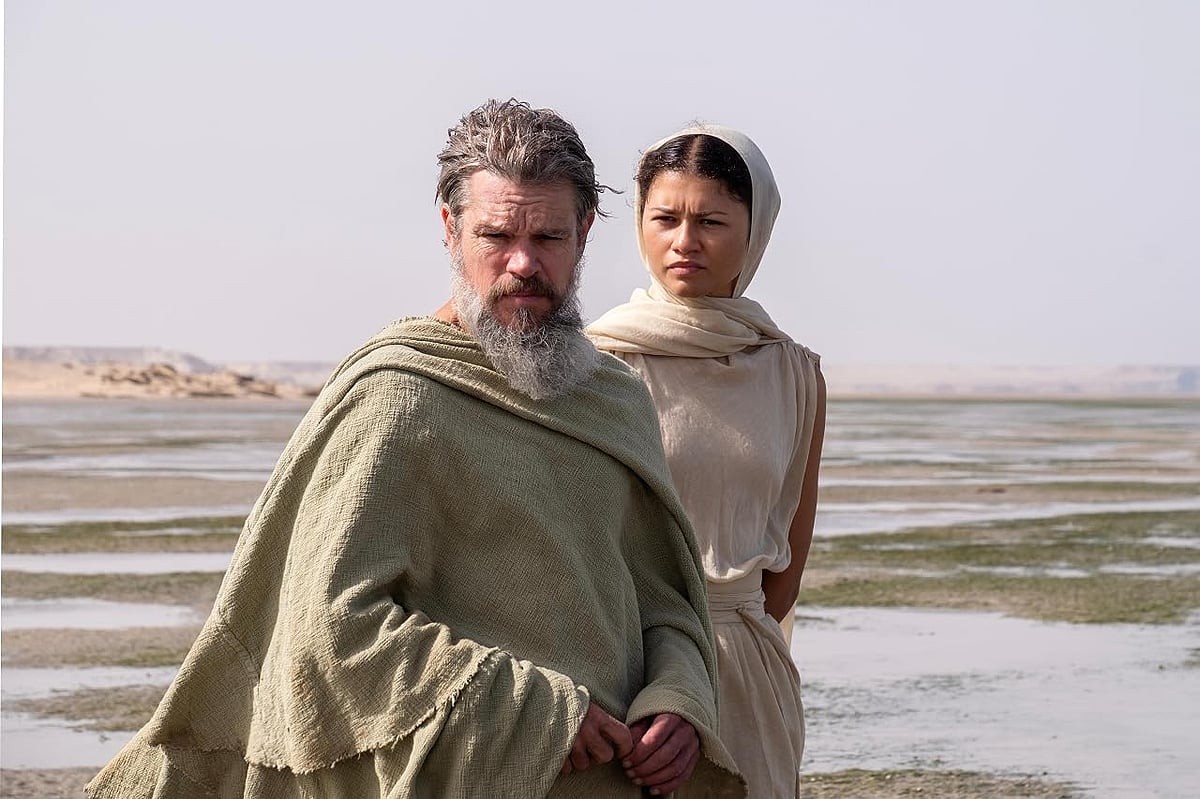
The Odyssey (English)At the core of Greek epics, like Homer’s The Odyssey, is the belief in xenia, or the code of hospitality to strangers. Who honours it and who doesn’t directly affects Odysseus’ journey home. The intrigue and betrayals in this 24-book epic poem are often also seen as violations of xenia, elevating it beyond the mere relationships between the many characters. The violation of xenia is central to Christopher Nolan’s feverishly anticipated adaptation, The Odyssey, starring Matt Damon as the war-tired king on his way to Ithaca. They call it Zeus’ Law in the film because he was believed to enforce xenia. The director’s long-term commitment to non-linear storytelling finds kinship in Homer’s Odyssey. The plot, like the epic, moves fluidly between events in no particular order. It isn’t confusing to follow along, but it does help to know the original poem and its vast number of characters. The Odyssey begins after the infamous Trojan War. Exhausted from ten years of sieges and battle, Odysseus sets sail for home. Because Greek gods rival even human capacities for pettiness and grudges, it will be another decade before he can reach Ithaca. Odysseus has the goddess of war and wisdom, Athena (Zendaya), on his side. But the sea god Poseidon is locked in a feud with him. Exploiting xenia, Odysseus had blinded Poseidon’s one-eyed giant son, Polyphemus, better recognised as the Cyclops. Poseidon cannot kill Odysseus. Zeus won’t allow it. But he can besiege Odysseus’ ship with storms and worse. Nolan’s Poseidon isn’t a CGI or motion-captured ancient deity rising out of the waters. He’s not even a recognisable entity. Instead, he is everywhere in the sheer, absolute power of the sea. This choice honours the animistic nature of gods like Poseidon. What computer graphics could ever conceive a giant more formidable than the ocean itself? True to Homer, Odysseus is no shining hero. Neither are his flaws romanticised. They are metaphors for the horror of war. Damon leaks weariness and inner conflict from every pore. You recognise easily that this is a man hurtling towards his overdue reckoning. In Ithaca, wait Penelope (Anne Hathaway) and Telemachus (Tom Holland), Odysseus’ wife and son. Both are also under a siege of sorts. Her ‘suitors’ grow increasingly threatening. Assuming Odysseus is dead, they insist that Penelope marry one of them. Since a woman’s choice keeps mattering so little, she can only hold them off through subterfuge. The most violent among the suitors is Antinous (Robert Pattinson). It is the women of The Odyssey who win hearts. Hathaway is a stellar Penelope. She embodies the fury of a woman who has all the responsibilities of leadership without recognition. There is a point when she growls at Holland’s Telemachus that the throne hasn’t been “empty” as everyone keeps saying since Odysseus left. She has sat on it every day, doing what a ruler must. It just doesn’t count because she’s not a man. Helen of Troy and her twin sister Clytemnestra, both played by Lupita Nyong'o, tell a similar story. Their lives and choices mean nothing in the schemes of powerful men. For all the racist meltdowns over Nyong'o’s casting, her scenes are minimal. But they are powerful. Helen’s rage is no less than Penelope's. She isn’t presented as a cheating wife who caused a war but as a woman who simply fled her marriage to a loveless, violent man. The war itself, she points out, was only ever waged in service to the greed of kings. Even the goddesses, whether Circe (Samantha Morton) or Athena, become allegories for the indignities and violence done to women under the cover of war. Circe’s witchcraft is her defence and sole protection against the men who pillage and rape on command. She forces Odysseus to acknowledge that. Their anger and pain are how Nolan condemns the Sack of Troy. The Trojan Horse becomes a symbol not of strategy and cunning in warfare, but of the betrayal of xenia. Troy truly believed the wooden horse was a gift to be taken into their home. The cost of their trust was borne by women. This may be why even the most dramatic moments of battle are never accompanied by conventional, frenzied orchestras. Instead, a roster of sounds that hardly go on to become actual music is a constant companion. Anything that can demarcate us as viewers and separate us from Odysseus and his men, Nolan doesn’t allow. We are made to bear witness. The abject chaos of battle is only scored by the beat of war drums all around and screams of terror. We hear each painful creak of Odysseus’ ships fighting through storms and whirlpools. Wars, Nolan seems to say, will not be cinematised to the point of editing out human suffering. It’s a commendable change from films like the 2004 Brad Pitt-starrer Troy. Oppenheimer (2023), for all its flaws, was ultimately an anti-war film. So is The Odyssey. But now, the accents and modern-day slang. As soon as the earliest promotional material dropped, viewers were in an uproar. Most of the cast, including British stars like Tom Holland and Robert Pattinson, had American accents. “More Ithaca, New York, than Ithaca, Greece,” The Hollywood Reporter observed. Who could have foreseen Odysseus screaming, “Let's gooo”, before charging into ranks of feather-helmeted, broadsword-wielding soldiers? Traditionally, Greek and Roman adaptations and even fantasy franchises prominently feature clipped British accents and wieldy dialogues. No one expected Nolan to defy that. So of course he did. And it raises the pertinent question: why should Greek characters sound British?Yes, it’s quite disorienting when Odysseus talks like he’s from Damon’s home state of Boston. Viewers complained that the accents lacked gravitas. But let’s not forget that expecting British accents from Greeks isn’t really about imaginary gravitas. It’s just colonialism when an accent, standardised barely a few centuries ago, is sold as ‘classical’. Shifting colours The Odyssey also seems to signal more shifts in Nolan’s on-screen politics. Or maybe it’s at least a reluctance to have his work co-opted again, like Dunkirk (2017) was, by the UK’s far right. His earlier Batman trilogy understandably remains a beloved adaptation for comic book nerds. However, his political views, embedded into the unlikely myth of benevolent billionaires, were questionable. Remember Bane (Tom Hardy), who wanted prison reform? He was ultimately made out to be a terrorist. Do you recall how the sequence of him crashing the Gotham City Stock Exchange was a pearl-clutching take on the real-life (and non-violent) Occupy Wall Street movement in New York? And the French Revolution. Dunkirk (2017), after that, did not help soften Nolan’s political undercurrents. The film’s appeal to white nationalist politicians like Nigel Farage made many queasy about the director’s own stance. Those doubts were only fuelled by the obvious erasure of South Asian and Black soldiers who historically fought on the shores of Dunkirk. Then came Oppenheimer in 2023. Though problematic in so many aspects, it feels like an anti-war film by the time the credits roll. Nolan presented a terror-inducing future of nuclear war and global suffering. The past few years have only made him sound even more prophetic. The Odyssey now features a dark-skinned Black actor as Helen of Troy, the woman whose famed beauty “launched a thousand ships”. It also features Eliot Page, a trans man. Has Nolan done enough to make Nyong'o's and Page’s casting meaningful rather than tokenistic? It’s difficult to say when so many characters pass through. Odysseus is the film’s centre. Nearly all the characters come and go like constellations around him. Though the secondary focus is on Penelope and Telemachus, Odysseus’ absence fills their lives, deciding every stroke. But the casting choices matter. They matter deeply. This isn’t the first time Page is playing a male-identifying character since he came out in 2020. Misgendering the actor or suggesting that he plays only trans men are both wrong. The obvious fact that Page can also play cis male characters if he chooses to shouldn’t be so challenging to grasp. Similarly, the racist outcry, spurred on by tech trillionaire Elon Musk, over Nyongo’s casting is symptomatic of the dire rot in the system. Hollywood has repeatedly whitewashed people of colour (POC) characters. The clamour for authenticity rears up only when class-privileged cis-het whiteness is replaced with melanin. I urge you to look up Scarlett Johansson’s response to criticism after she essentially stole the role that should have gone to a Japanese actor in Ghosts in the Shell (2017). Why didn’t the live-action adaptation of a cult favourite manga and anime series feature a Japanese woman as Motoko Kusanagi? Why was a South East Asian priestess from the comics played by Tilda Swinton in Marvel’s Doctor Strange (2016)? Also consider the countless ‘classics’ set in ancient Egypt, all starring white actors in brownface. What historic sources say Cleopatra was a white woman like Vivian Leigh or Elizabeth Taylor? Now compare these trends to Lord of the Rings (LOTR) star Andy Serkins’ recent rant about ‘authenticity’ and the Norse mythology JRR Tolkien referenced in the original fantasy novels. Serkins was responding to POC fans questioning the all-white casting in the upcoming The Hunt for Gollum. Peter Jackson’s adaptations and Tolkien’s books still mean more than can be possibly contained in a few lines to many POC fans like me. But I was thrilled that Game of Thrones (GoT) showrunners wrote in Black characters when asked to helm the LOTR spin-off series, Rings of Power. The quality of writing didn’t match up to Jackson's, so the show received a lukewarm response. But racist fans were quick to blame the casting. These examples can be found guilty of tokenism in various degrees. But the point is that so few even exist. That’s why the inclusion of dark-skinned actors in the GoT spin-off House of the Dragon left one Black pop culture content producer in tears. It’s crushing when the ache to see more melanin in the stories we love best is coldly brushed off under the cover of 'authenticity', whether in fantasy fiction or mythology. Even more so when the same metric is suspended each time a canonically POC character is played by a white actor. The reason Lupita’s casting enrages a section of viewers, including South Asians, is their own racism and colourism. The crusaders for authenticity notably failed to protest when Sienna Guillory and Diane Kruger played Helen in previous adaptations. Where does it say the ancient Greeks were all blonde? It all boils down to the fact that, to white nationalists and many South Asians, a woman can’t be beautiful without being pale-skinned. Happily, for the rest of us, The Odyssey and Nolan have disregarded them. Disclaimer: This review was not paid for or commissioned by anyone associated with the film. Neither TNM nor any of its reviewers have any sort of business relationship with the film’s producers or any other members of its cast and crew.