
Delhi protests: Similar pattern of protestor injuries puts RAF‘s MO under scrutiny
Six days after the July 20 crackdown near Parliament, neither the CRPF nor its Rapid Action Force wing has clarified whether their personnel fired pellet guns at protesters. As of publication, the force has neither publicly confirmed nor denied their use, even as The Indian Express reporte
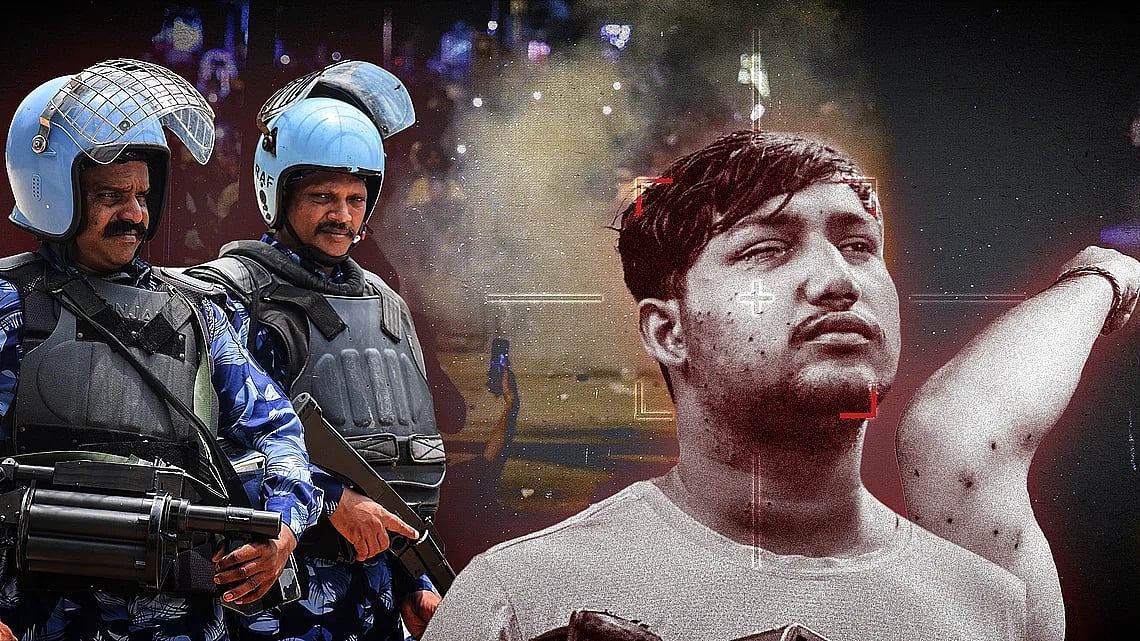
Six days after the July 20 crackdown near Parliament, neither the CRPF nor its Rapid Action Force wing has clarified whether their personnel fired pellet guns at protesters. As of publication, the force has neither publicly confirmed nor denied their use, even as The Indian Express reported that an internal inquiry found that seven rounds were fired from a pellet gun.On Monday, the Supreme Court will hear two petitions alleging police excesses as the Delhi Police faces questions over its response to the protest march called by the Cockroach Janta Party. But the force at the centre of the pellet injury allegations is the RAF – a CRPF wing trained in riot control, crowd management, negotiation and the use of less-lethal and minimum force. Its official motto is “Serving Humanity With Sensitive Policing”.An RAF official deployed at Jantar Mantar, speaking on the condition of anonymity, said its personnel follow a “graded response” to control a “violent crowd”. “We first use lathis, then tear gas, followed by pellet guns if required,” he told Newslaundry. On the 12-bore pump-action shotgun, used to fire pellets, he said: “We do not use a 12-bore pump-action gun on our own. If the situation warrants its use, an executive magistrate who is present at the spot authorises its usage. We never fire pellets without such authorisation.”Set against the motto, that account and the force’s own guidelines are two things.The first is a video from that afternoon, one of many circulating since, in which a man in the blue camouflage of the RAF can be seen firing a 12-bore pump-action shotgun outside the Pind Balluchi restaurant at the Regal cinema complex in Connaught Place.The second is the pattern of injuries. At least four people suffered pellet-like injuries on July 20, and in every case Newslaundry reviewed, the wounds were above the waist – eyes, face, neck, shoulders, chest, arms and back. A 19-year-old student may permanently lose vision in his right eye. A 25-year-old still has a pellet lodged near a major blood vessel in his neck, too close to remove. A reporter is carrying an estimated 25 to 30 of them in his body.Now consider the force’s own rulebook. The Ministry of Home Affairs' 2011 Standard Operating Procedures for handling public agitations with non-lethal measures state that where such fire is required, the line of fire should be kept below the waist to reduce fatalities. It was the same logic that led the CRPF to fit its pellet guns with muzzle deflectors in 2017, an attachment designed to push the spread downward, and to instruct personnel to aim low. Whatever was authorised on July 20, and by whom, the wounds it left were not where the protocol says they should have been.Media reports indicate the RAF chief has told its personnel that the force gradient for crowd control was not adopted in accordance with the RAF training and standards on July 20 – the force is examining the matter.So what follows is an account of the four cases, the graded-force protocol the RAF says it follows, and a decade in which the Union government has repeatedly promised alternatives to the pellet gun without ever retiring it.Shaikh Irshad Mansoori Location: Near Palika BazarTime: Around 5 pm Shaikh Irshad Mansoori, a 25-year-old resident of Jabalpur, Madhya Pradesh, who works at a private firm in Gurugram, was among the first protesters reported to have sustained pellet injuries during the July 20 march. He was injured near Palika Bazar and admitted to Lady Hardinge Medical College, where doctors operated on July 21 to remove multiple pellets lodged in his face. According to Mansoori, the projectile struck his left eyebrow and shattered, sending fragments into different parts of his face. He said doctors flagged three pellets as particularly dangerous: one in his neck, close to a nerve and a major blood vessel; another near the muscle controlling his left eye, which could have affected his eye movement; and the third one on the right side of his face, near the nose, inside the facial cavity. Before the operation, hospital staff warned that injuries close to his eye carried a risk to his sight. Surgeons removed several pellets from his face and neck, but the one lodged in his neck could not be extracted because it was close to a major blood vessel. Outlook journalistLocation: Palika BazarTime: Around 4 pmAn Outlook India reporter covering the July 20 protest was also injured near Palika Bazar. According to the publication, the security personnel raised a firearm in his direction. The reporter instinctively turned away and ran moments before it was discharged. He later recalled that the projectile struck his backpack and right arm, saying that had he not turned, it could have hit his chest or face. Medical records prepared after the incident documented multiple puncture wounds on his right arm, while a clinical assessment at Safdarjung Hospital recorded 26 small, round wounds on the right side of his body, consistent with pellets striking at an oblique angle. The magazine published X-rays and photographs showing multiple pellet injuries in his arm. Subsequent reports, including his own account, stated that around 25–30 remained lodged in his body, with injuries extending to his right arm, chest and back.Sahil LochabLocation: Palika BazarTime: Around 3 pmSahil Lochab, a 19-year-old Delhi University student from Najafgarh who was preparing for a Delhi Police recruitment exam, was carrying the Tricolour at the front of the march when he heard an explosion near his face. He was admitted to the AIIMS Trauma Centre, where doctors performed surgery to remove multiple metallic pellet fragments from his right eye. According to his family, the doctors have warned that he only has a minimal chance of regaining vision in the eye and that he could suffer permanent blindness. In addition to the eye injury, reports state that he sustained pellet injuries to his shoulders and torso. Unidentified protesterA fourth protester with pellet-like injuries has also appeared in videos circulating widely on social media, including footage shared by Alt News co-founder Mohammad Zubair. Although the individual’s identity and medical records have not been publicly confirmed, the videos appear to show multiple pellet-like puncture wounds across the face and upper body. No verified medical documentation is available to establish the precise locations or extent of the injuries. As with the other documented cases, the visible injuries appear to be above the waist, adding to calls for an independent inquiry into the reported use of pellet guns during the July 20 protest.Human rights concernsAn army veteran and security expert, on the condition of anonymity, told us, “Discharge of firearms (even pellet guns) is the last resort. The crowd has to be warned before fire is opened. Police have to fire in the air to warn the crowd…Pellet guns can and have caused permanent blindness and grave injuries. It is only one step away from live rounds being fired. Weapons can only be discharged if there is a credible threat to the life of either security forces or civilians or grave national asset damage.”Multiple videos appear to show Delhi Police personnel and Rapid Action Force (RAF) personnel deployed during the July 20 protest without visible name tags on their uniforms. On this issue, he said, “The uniformed forces have to wear all elements of their uniform.”International human rights organisations have often criticised the use of pellet-firing shotguns for crowd control because of their indiscriminate nature and the risk of causing severe eye injuries, blindness and death. In its reports on Kashmir, the Office of the United Nations High Commissioner for Human Rights (OHCHR) described pellet-firing shotguns as among the most dangerous weapons used by security forces and called for an immediate end to their use for crowd control. The UN Human Rights Office’s 2020 Guidance on Less-Lethal Weapons in Law Enforcement states that metal pellets fired from shotguns should never be used because such multi-projectile weapons are inherently inaccurate and cannot, in general, comply with the principles of necessity and proportionality.A decade of failed alternativesThe alleged use of pellet guns during the July 20 protest in Delhi revives a question the Union government has grappled with for nearly a decade: should the weapon be used for crowd control at all? Since the 2016 unrest in Kashmir, the government has repeatedly faced criticism for the injuries caused by pellet guns, explored multiple alternatives and modified the weapon itself. Yet, despite these efforts, pellet guns have remained part of the security forces' crowd-control arsenal.Following widespread criticism after the 2016 unrest in Kashmir, the Union government initiated a series of efforts to identify less harmful alternatives. In July 2016, the Ministry of Home Affairs constituted a seven-member expert committee headed by T V S N Prasad, then joint secretary in the ministry. The committee comprised Atul Karwal (Inspector General, CRPF Srinagar), Rajeev Krishna (Inspector General, Operations, BSF), Rajesh Kumar (IPS, Jammu and Kashmir Police), Tushar Tripathy (Deputy Director General, Small Arms, Ordnance Factory Board), Dr Manjit Singh (Director, TBRL, Chandigarh) and Dr Naresh Bhatnagar (Professor, IIT Delhi).It submitted its report on August 29, 2016 and recommended several alternatives to pellet guns, including PAVA (Pelargonic Acid Vanillyl Amide, or nonivamide) shells – a chilli-based munition intended to temporarily incapacitate crowds – as well as stun-lac shells, Long Range Acoustic Devices (LRADs) and plastic tear-gas shells. Home Minister Rajnath Singh subsequently approved the use of PAVA shells, and the first consignments were sent to Jammu and Kashmir in September 2016. However, CRPF officials later said PAVA shells were only partially effective in dispersing crowds. Rather than replacing pellet guns, the force continued to retain them while modifying the weapon to reduce the severity of injuries.In 2017, the CRPF introduced a modified version of the 12-bore pump-action pellet gun fitted with a metal “deflector” – an attachment on the muzzle intended to direct pellets downward and reduce injuries above the abdomen. The force claimed the modification would reduce the chance of pellets rising above the point of aim from 40 percent to 2 percent and instructed personnel to aim below the waist. However, a report by The New Indian Express challenged these claims. It reported that the deflector could block only a small fraction of the pellets and that even slight movement by the shooter could cause pellets aimed at the legs to strike the upper body. The publication also highlighted inconsistencies in the CRPF’s own claims. Inspector General Atul Karwal, who also served on the MHA expert committee, said around 90 percent of pellets would hit below the waist, implying that roughly 10 percent could still strike above it. CRPF spokesperson Rajesh Yadav told The Caravan that the deflectors had been tested only in “static and ideal situations”, describing them as a local improvisation. He acknowledged that real-life deployment would be different from controlled testing. The search for alternatives continued. In 2019, alongside earlier modifications to the pellet gun, DRDO unveiled a plastic bullet as another proposed alternative for crowd control. The ammunition was developed by the Terminal Ballistics Research Laboratory (TBRL), Chandigarh, and designed to be fired from the AK-47 and AK-56 rifles already used by the CRPF, allowing forces to switch ammunition without changing weapons. In 2019, DRDO showcased the plastic bullet at the 106th Indian Science Congress in Jalandhar. Speaking at the event, Dr Manjit Singh said, “A solution was needed for the notorious pellet gun.” DRDO Chairman G Satheesh Reddy said the new ammunition was “500 times less injurious” than conventional pellet rounds. This weapon should not be confused with the introduction of plastic-tipped pellets, which remained compatible with the 12-bore pump-action pellet gun and were intended only to reduce skin penetration. Despite the repeated announcements of alternatives after 2016, pellet guns were never phased out. A Jammu and Kashmir government spokesperson told Al Jazeera that a decision had been taken to phase out pellet guns, but this was never implemented. In an affidavit filed before the Jammu and Kashmir High Court in response to a public interest litigation seeking a ban on pellet guns, the CRPF argued that withdrawing the weapon would leave personnel with no option but to use rifles, potentially causing more fatalities. Pellet guns therefore remained part of the force’s crowd-control arsenal.Over time, allegations of pellet gun use also spread beyond Jammu and Kashmir. During the ethnic violence in Manipur in September 2023, students and civil society groups alleged that security forces, including the Rapid Action Force, used pellet guns against protesters, leaving hundreds injured, including several with pellet wounds. Similar allegations surfaced during the farmers' protests at the Shambhu and Khanauri borders in February 2024, with farmers and Punjab officials alleging the use of pellet guns while Haryana Police denied the claim. The allegations surrounding the July 2026 protest in Delhi therefore represent the first reported instance of pellet guns being used for crowd control in the national capital.Throughout this period, the Ministry of Home Affairs has maintained that pellet guns are intended only as a measure of last resort. In replies to Parliament, the ministry has said security forces are expected to escalate through warnings, tear-smoke shells, PAVA shells and grenades, and STUN-LAC munitions before resorting to pellet guns, and only when these measures fail to disperse a violent crowd. This is consistent with the Ministry’s 2011 SOP.Against this backdrop, the events of July 20 raise important questions about the use of pellet guns. The issue is not merely whether pellet guns were fired, but whether the circumstances justified their use and whether the safeguards laid down by the government itself were followed. Speaking on the July 20 action, former home secretary Gopal Krishna Pillai said, “I remember very clearly that the decision in the ministry was that pellet guns should not be used because they cause random damage. When fired from a distance, the pellets spread and, instead of hitting the legs, they can strike the face.”“There is no evidence that the police were being overwhelmed or that the crowd was going to attack them. From what little I have seen, it appears to have been a crowd-managem