
'Mere agitation can't justify lathi-charge': CJI on NEET protest pleas
Follow TNM’s WhatsApp channel for news updates and story links.The Supreme Court, on Monday, July 27, observed that the right to peaceful and lawful protest is constitutionally protected and that the existence of an agitation cannot, by itself, justify police excesses, including the use of
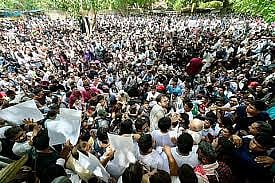
Follow TNM’s WhatsApp channel for news updates and story links.The Supreme Court, on Monday, July 27, observed that the right to peaceful and lawful protest is constitutionally protected and that the existence of an agitation cannot, by itself, justify police excesses, including the use of force against protesters. Hearing a batch of petitions arising out of the alleged police action during the July 20 student protests in Delhi over the NEET paper leak controversy and examination irregularities, the court also underscored the need for a uniform national protocol governing police handling of demonstrations.A Bench comprising Chief Justice of India Surya Kant and Justices Joymalya Bagchi and V Mohana made the observations while hearing mentions relating to multiple petitions alleging excessive police force against students who participated in protests across the country.Chief Justice Surya Kant orally observed, "Right to peaceful, lawful protest absolutely guaranteed under Constitution. So long as it is peaceful agitation, merely because there is agitation, there can't be [excess]... If there is excess committed, it should be independently examined. It's not only a case of Delhi. Uniformity in protocol required. Merely because agitation there, doesn't mean lathi-charge. Discipline integral to democratic process."The Bench directed that all connected petitions, including intervention applications, be listed together for hearing on July 28.The court also agreed to hear a separate plea filed on behalf of family members of police personnel who were allegedly injured during the protests. The counsel sought permission to place the perspective of police personnel before the court, submitting that they too required protection while performing duty.Justice Joymalya Bagchi said injuries suffered by protesters and police personnel deserved equal concern. He observed, "Injury to individual, be it to policemen or [students], is of equal concern. We may call upon state to concern why adequate equipment not given to police to handle such... they should have helmets."The petitions seek wide-ranging directions to regulate police conduct during public protests, including a ban on the deployment of plainclothes personnel for crowd-control operations, guidelines governing the exercise of powers under Section 163 of the Bharatiya Nagarik Suraksha Sanhita (BNSS), and an independent probe into the police action during the July 20 protest in the national capital.One of the petitions, filed by advocate Shailendra Mani Tripathi, also seeks enforcement of fundamental rights under Articles 14, 19 and 21 of the Constitution, alleging that the July 20 protest march towards Parliament was met with extensive police deployment, barricading, tear gas, baton charges and large-scale detentions. The plea further alleges physical assaults on protesters, gender-based misconduct against female protesters and the use of force by unidentified or plainclothes personnel, while claiming that at least 60 protesters were injured.The petition sought the constitution of an independent Judicial Commission or a Special Investigation Team headed by a retired Supreme Court judge to investigate the alleged police excesses, gender-based violence and arbitrary detentions during the July 20 protest. It also sought directions for registration of an FIR against police personnel allegedly involved in assaults and sexual abuse of female protesters, besides their identification, suspension and prosecution.The plea also urged stricter constitutional safeguards against the invocation of Section 152 of the Bharatiya Nyaya Sanhita (BNS), contending that it should not be used against political dissent, peaceful protests or criticism of the government unless there is direct and imminent incitement to armed rebellion or secessionist violence.The petitions further requested implementation of the police reforms directed by the Supreme Court, including the establishment of independent Police Complaints Authorities, mandatory human rights and crowd-control training for police personnel, and standard operating procedures for regulating the use of prohibitory orders under Section 163 of the BNSS.The matter will now be heard on July 28 along with all connected petitions and intervention applications.