
Modi govt’s PM internship scheme 99% behind target, ad spend rivals stipends
It was the summer of 2025. The advertisements about the Narendra Modi government’s new internship scheme were splashed across newspapers, TV channels and social media. Like lakhs of others, P Adarsh*, 22, noticed them from his hometown Bhilai in Chhattisgarh. After finishing his degree in agricultur
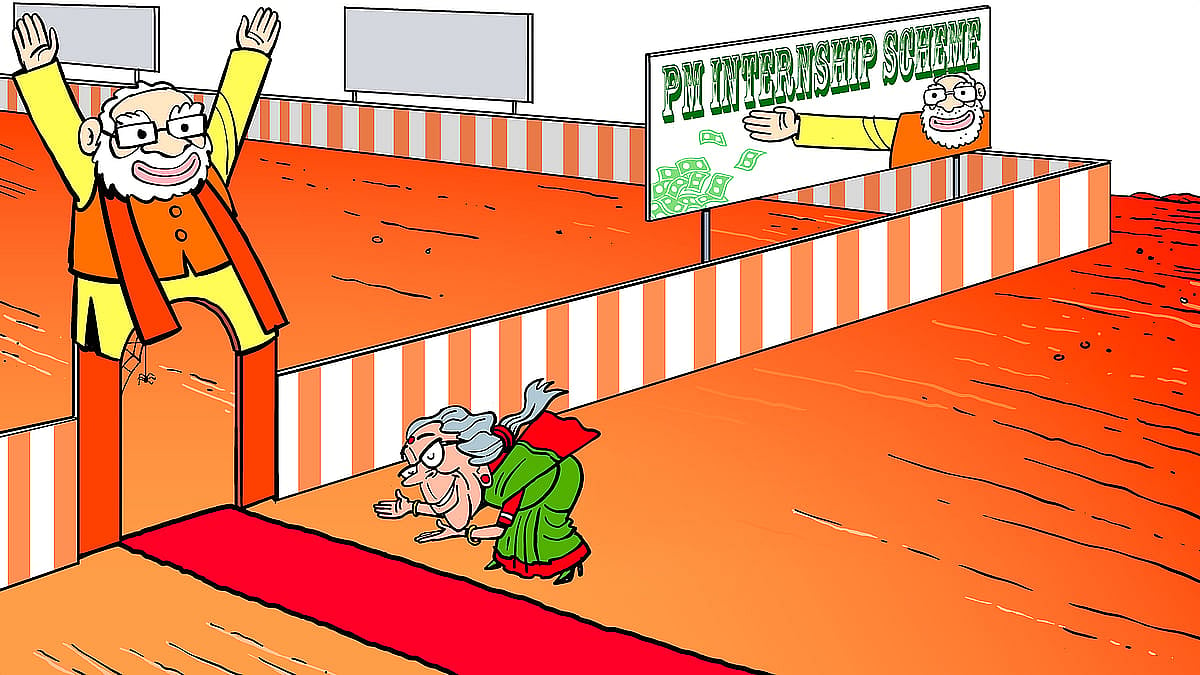
It was the summer of 2025. The advertisements about the Narendra Modi government’s new internship scheme were splashed across newspapers, TV channels and social media. Like lakhs of others, P Adarsh*, 22, noticed them from his hometown Bhilai in Chhattisgarh. After finishing his degree in agricultural engineering a while ago, Adarsh was hunting for an internship that could sharpen his skills, pay some money, and still leave him evenings to prepare for a bank job exam. So he applied through the Prime Minister’s Internship Scheme (PMIS) portal that was advertised, specifying his preferences, and got an email saying he had been selected for an internship. It was at a PSU, Bharat Petroleum (BPCL), in state capital Raipur.But he didn’t take it.Instead, he travelled to Anantpur in Andhra Pradesh, to the Southern Region Farm Machinery Training and Testing Institute, for an internship he had been selected for through the National Apprenticeship Training Scheme (NATS).“At the time, I was desperate and applied for multiple internships,” Adarsh says, candidly, on a phone call. Joining the BPCL internship would have meant commuting 60 km daily and the money for that would have to come out of the Rs 5,000 that was to be his monthly stipend under PMIS. In contrast, Anantpur meant a free bed at the government institute hostel, and the only major expense would be Rs 3,000 on food but the Rs 12,300 stipend would easily cover that. It was also in a domain connected to what he had studied, unlike the PMIS internship which was in a completely unrelated field. His experience may sound like a cautionary tale but it’s far from an exception. The Prime Minister’s Internship Scheme was read as the Modi government’s answer to the jobs anger of 2024. Finance Minister Nirmala Sitharaman had announced it in the first budget after the Lok Sabha results with a target that made big headlines: internships for 1 crore youth in 500 top companies in five years, 30 lakh of them in the first two. But two years on, the distance between those numbers and the ones the government actually reports looks too vast to bridge.Responses to a Right to Information (RTI) application filed with the Ministry of Corporate Affairs, which runs the scheme, show that till April 30, 2026, companies posted 2.97 lakh internship opportunities – nearly a tenth of the two-year target. The picture gets more bleak. These opportunities shrunk to 1.73 lakh actual offers. About 18,000 of those given these offers showed up for work. Only around 5,200 stayed to the end. This is all against a total of 12 lakh applications sent via PMIS. The money reflects the same underwhelming reality. Of the Rs 63,000 crore initially announced for the PMIS over five years, Rs 123.7 crore, or less than 0.2 percent of the total, has actually been spent until March 15, 2026 – nearly two financial years into the scheme. Of this sliver, the government spent Rs 46.7 crore on marketing and advertising, a sum that’s just a few crores less than the Rs 54.3 crore it has actually spent on paying the interns. The remainder went towards other costs that the records do not clearly break down.Why has a scheme tasked with solving a real problem, and armed with the resources to solve it failed to find enough takers? The RTI responses, combined with data presented in Parliament, interviews with former interns, companies, economists and others, reveal a scheme falling far short of its promise for a host of reasons, some of which have been documented by the government’s own evaluators. Along the way, it raises the question of announcing ambitious targets without a clear pathway to get there. A deepening crisisPMIS was announced on July 23, 2024 in the budget of the re-elected National Democratic Alliance government. “Our government will launch a comprehensive scheme for providing internship opportunities in 500 top companies to 1 crore youth in five years. They will gain exposure for 12 months to real-life business environment, varied professions and employment opportunities,” Nirmala Sitharaman had said in her budget speech. It was one of five schemes announced that day for youth skilling and employment, with a total outlay of Rs 2 lakh crore. The NDA government had been sworn in for a third consecutive term but the BJP’s seat tally had shrunk to 240 from 303. The party had courted first-time voters and the youth hard and multiple surveys had pointed out that employment was top of mind for this section. The newspaper coverage the morning after the budget took note that the government had blinked. One editorial remarked that the budget “was more about coming to terms with the compulsion of coalition politics and calming frayed sentiments over jobs than about big ideas or bold reforms”.India has been struggling with how to generate enough jobs for its vast number of youth – estimated at 367 million in the age group of 15- to 29 years – for years. Of this, the 263 million who are not pursuing education make up the potential workforce. Of the Rs 63,000 crore initially announced for the PMIS over five years, Rs 123.7 crore, or less than 0.2 percent of the total, has actually been spent until March 15, 2026. Of this sliver, the government spent Rs 46.7 crore on marketing and advertising.The money reflects an underwhelming reality.Over the years, education levels have increased considerably, with the country now churning out 5 million graduates annually. But graduate unemployment has remained high, reaching close to 40 percent among 15- to 25-year-olds, according to the State of Working India 2026 report by Azim Premji University. Of the 5 million graduates, only about 2.8 million annually are able to find jobs, a trend that’s held since 2004-05. Of this, an even smaller share is able to secure stable, salaried jobs within a year of graduating, the report points out. In 2023, close to 70 percent of the unemployed youth in the country, or about 11 million, were graduates, up from 44 percent in 2011. In May, the unemployment rate for those between 15 and 29 years stood at 15.9 percent, nearly thrice the unemployment rate for those aged 15 years and above (5.5 percent), according to the Periodic Labour Force Survey. This is the crisis that finds expression in protests over botched recruitment exams, lakhs of youngsters queuing up for a few thousand vacancies and most recently, is considered by analysts to be a factor in the rise of the Cockroach Janta Party. At the other end of the spectrum sit complaints by India Inc, about the lack of employability of graduates. Infosys co-founder NR Narayana Murthy had claimed in 2018 that 80 percent of Indian youngsters “are not trained suitably for any job”. Fellow IT stalwart CP Gurnani of Tech Mahindra had said 94 percent of engineering graduates are not fit to be hired. More recently, the India Skills Report estimated that just over half the graduates in India were employable, an improvement from a third a decade ago but still a large share. It was to plug this gap “between academic learning and industry demands” that PMIS was ostensibly launched, according to government statements. As designed originally, the scheme was to offer a 12-month internship in India’s top 500 companies, listed on the basis of average corporate social responsibility spending over three years, to anyone aged 21 to 24 years who was not employed or studying full-time and had passed high school. Company participation was voluntary. Interns would get Rs 6,000 on joining, insurance through government schemes and Rs 5,000 as monthly allowance. Of the latter, 10 percent would be paid by company CSR funds, which worked out to Rs 500, with the remaining Rs 4,500 paid by the government. Companies would also bear the training costs. This was the format for the first two rounds of the pilot. It has since been modified.The first round of the pilot was launched on October 3, 2024 and the initial response looked promising, with 1.8 lakh candidates submitting 6.21 lakh applications, and 280 companies posting 1.27 lakh internship opportunities, according to Standing Committee reports presented in Parliament. In the next round, launched in early 2025, the number of participating companies increased to 327 but the number of internship opportunities posted reduced to 1.18 lakh. The third pilot, which started in March, is currently under way. Cumulatively, till the end of April 30, over 12 lakh applications were received, close to 3 lakh opportunities posted by companies and 1.73 lakh internship offers made to candidates, according to the RTI response. But across these, just 18,000 interns finally joined with only 5,200 interns completing their internship. In the first pilot round, over half the candidates who joined dropped out. In Round 2, the dropout rate improved to 33 percent but the number of interns who joined were also fewer by about 1,500. In total, over 7,600 dropped out, according to the ministry’s RTI response. Considering only about 5,000 interns completed the one-year stint, the number of dropouts should be higher but this discrepancy was not explained. The gender breakup of joinees also heavily skewed male in the first two rounds, with over 11,000 male candidates and 5,000 female candidates. The budgetary outlay and expenditure are equally revealing of the contrast between expectation and the reality of the scheme. According to a report by the standing committee on finance on the ministry of corporate affairs’ demands for grants 2025-26, the total financial outlay for PMIS over five years was pegged at Rs 63,000 crore in budget 2024-25. To meet the target of 1 crore internships, this was to be split into Rs 19,000 crore for the first and second year for 30 lakh internships, and Rs 44,000 crore for the next three years, for 70 lakh internships. But so far, the expenditure, too, has fallen far short. In 2024-25, the year it was launched, the scheme was allotted Rs 2,000 crore. The revised estimate was then reduced to Rs 380 crore, of which actual expenditure was Rs 29.29 crore, a fraction of the outlay. For the next financial year, FY26, the scheme was allocated an even larger amount, at Rs 10,831 crore. This became Rs 526 crore in the revised estimate, while actual expenditure, up to March 30, 2026 was Rs 94.48 crore. This shortfall, the ministry stated according to the Standing Committee Report, was because the main scheme could not be started yet, and the pilot project was still running. Questions were emailed to the ministry seeking comment about the findings and the scheme’s progress, but there was no response despite multiple follow-ups. This report will be updated if a response is received.Idea vs implementationMultiple experts who were interviewed, and interns themselves, said that in theory, this was a good scheme – particularly to ease the education to jobs transition. “It’s good if institutes have training infrastructure but students don’t really get training unless industry trains them,” says Sougata Roy Choudhury, executive director of the Confederation of Indian Industry (CII), a partner in the scheme, and head of the CII-Rahul Bajaj Centre of Excellence on Skills. “We had been advocating for the scaling up of an apprenticeship-like model, but with more flexibility, and which could use CSR funds.” The ministry did acknowledge several concerns and announced a few modifications. Based on the experience of Round 1, this included changes like reducing the number of applications per applicant from five to three, making the name of the company and any additional benefits more visible, and encouraging companies and states to have dedicated PMIS cells. However, these did not address several core complaints from interns.Shantanu Rooj, founder and CEO of TeamLease Edtech, a skilling and employability solutions provider, says that providing internships as a pathway for students to get into employment was great from a concept perspective. But the best of intentions cannot paper over flaws in design and execution. “I think some of the policymakers believed that just ensuring that youngsters have access to these open positions is enough to solve this problem,” he says. The challenges, he adds, arise more from an execution deficit than an ideas deficit. According to him, PMIS did two things: it made discovery of internships easy, and it offered an incentive. But both came with challenges. In the first case, while there were a large number of applications, limiting employers to 500 meant that many of the opportunities were concentrated in a few regions, particularly the metro cities, and the stipend would need to cover the costs of staying in those cities for candidates from other locations. And while the government paying Rs 4,500 a month was, in his words, “a noble concept,” delays in crediting the amount proved frustrating. “Imagine a candidate travels to Bangalore for his internship but his stipend does not come on the first or even seventh day of the month. How will he pay his rent? He will leave,” says Shantanu. Akriti Saxena, a BBA graduate from FUEL College, Pune, who completed her internship with Lemon Tree Hotels during the first PMIS pilot, experienced this first-hand. She says her payment used to get delayed because the portal used to be slow and did not immediately reflect that the company had released her payment, which was a condition for the government to release its share of the stipend. Akriti, now 23, says she was able to manage because the company increased her stipend by another Rs 3,500 (companies have the option to do this) and she could stay in the college hostel. “But some people got internships in other cities, and Rs 5,000 would be very less then.”Ramesh Swamy, director of Unnati Foundation, a not-for-profit which provides vocational training and skilling for underprivileged youth, particularly from rural areas, expresses similar sentiments while lauding the idea of PMIS. “The government thought that it will create a portal and things will happen. But that’s not how it works right?” He said people would automatically apply when they saw a government opportunity, but the biggest challenge, in his experience with working youngsters, was the location of internships. “It would be a very small percentage who would be willing to relocate for an internship. They will think about whether the stipend will cover their expenses, the cost of living in a city, etc.”Adarsh’s reasons for not taking up the BPCL internship he was selected for – an inadequate stipend, an inconvenient location, an unconnected role – were evidently not unique to him. The ministry of corporate affairs, in a written reply to Parliament on the reasons for the low number of candidates joining and the dropouts, acknowledged as much, stating that candidates mentioned 5-10 km as ideal travel distance and that