
Pellet guns in Delhi protests: What the government’s own SOPs say about their use
The use of pellet guns during the July 20 ‘Chalo Sansad’ protest at Delhi’s Jantar Mantar has come under scrutiny after official records and a petition before the Supreme Court raised questions over whether pellet guns are authorised for civilian crowd control under the Union government’s and Delhi
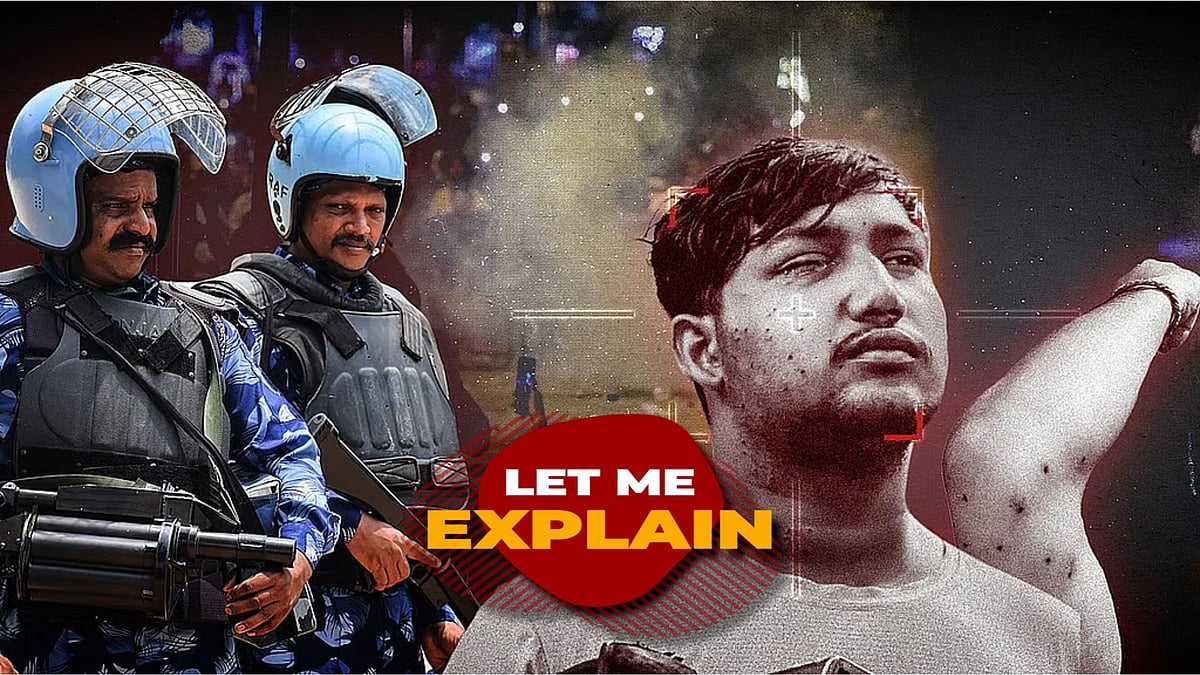
The use of pellet guns during the July 20 ‘Chalo Sansad’ protest at Delhi’s Jantar Mantar has come under scrutiny after official records and a petition before the Supreme Court raised questions over whether pellet guns are authorised for civilian crowd control under the Union government’s and Delhi police’s own protocols.Pellet guns and shock batons are part of the equipment used by the Rapid Action Force (RAF), the anti-riot wing of the Central Reserve Police Force (CRPF), which was deployed alongside Delhi Police during the protest organised by the Cockroach Janta Party (CJP) demanding the resignation of Education Minister Dharmendra Pradhan.This was the first reported instance of pellet guns being used in the national capital against unarmed protesters. At least three people, Irshad Sheikh (25), a Gurgaon-based worker; Sahil Lochab (19), a Delhi University student; and a 28-year-old journalist with Outlook magazine, were treated in hospitals for pellet injuries. Lochab’s family said a pellet pierced his right eye and that he risks losing vision.A general diary entry at Parliament Street police station on July 20 stated that RAF personnel fired two rounds from an anti-riot gun loaded with ballistic cartridges containing plastic pellets on the directions of a Deputy Commissioner of Police (DCP)-rank officer. The entry also recorded the use of 55 non-electrical shells, 15 electrical shells and five tear smoke grenades during the crackdown.What do the official SOPs say?Crowd-control SOPs are not routinely available as public documents. The 2011 Standard Operating Procedures (SOPs) to deal with Public Agitations with Non-Lethal Measures, prepared by the Bureau of Police Research and Development (BPRD), came to light after RTI activist Venkatesh Nayak obtained a copy through a Right to Information application. Nayak had filed the application in 2012, following reports of police brutality during protests across India, seeking details of the guidelines governing the use of force by law enforcement agencies.The SOP lays down a graded approach to crowd control, directing police to first attempt to disperse unlawful assemblies through persuasion, negotiation and warnings.If those measures fail, police may use minimum force, beginning with non-lethal measures such as lathi charge, water cannons, tear smoke shells and other less-lethal weapons. Firearms can be considered only if these measures prove ineffective and even then only as a last resort. The SOP states that force must be proportional, used only when absolutely necessary, and discontinued once violence stops. If firing becomes unavoidable, officers are instructed, as far as practicable, to aim below the waist.The SOP also requires police to provide immediate medical assistance to injured persons, contain violence within the smallest possible area, and ensure that crowd-control operations follow principles of necessity and proportionality. The 2011 SOP does not mention pellet guns among the approved crowd-control measures.Delhi Police’s standing ordersDelhi Police’s Standing Order No. 72, issued in January 1989, similarly emphasises restraint, discipline and minimum force while dispersing unlawful assemblies. It authorises an Executive Magistrate or designated police officers to order dispersal and, if necessary, use force. However, it repeatedly stresses that officers must act with “utmost restraint and patience” to prevent escalation and minimise loss of life and property. The standing order lays down operational safeguards, including maintaining formations and the chain of command, ensuring that officers carrying rifles, muskets or tear smoke guns do not open fire unless properly deployed, and requiring personnel to wear protective equipment such as steel helmets and shields. It also specifies that tear gas guns and grenades must be operated only by trained personnel. Before tear gas or firearms are deployed, personnel positioned between the crowd and the armed squad must first be withdrawn. The order requires dispersal operations to be conducted through coordinated unit formations rather than individual action. It makes no reference to pellet guns. The 2022 Delhi Police Standing OrderDelhi Police's Standing Order L&O/10/2022, issued by Commissioner Rakesh Asthana on May 25, 2022, provides operational guidelines for regulating rallies, demonstrations and processions in the national capital.The order prescribes a three-tier barricading system. The first layer consists of police personnel without lathis, equipped only with helmets and body protectors. The second layer carries cane shields, while only the third layer is equipped with full riot-control gear, including lathis and tear gas.The standing order states that force should be used only on the directions of senior officers and in a manner that causes the least possible injury. It requires repeated announcements through public address systems before force is used, mandates videography of the operation, and directs police to ensure immediate medical assistance for injured protesters and police personnel. It also provides for the deployment of water cannons, Vajra vehicles and tear gas wherever necessary.Like the earlier SOPs, the 2022 standing order does not include pellet guns among the prescribed crowd-control equipment.The 2016 exceptionThe Union government did formulate a separate SOP in 2016 following criticism over pellet gun injuries in Jammu and Kashmir. Though this SOP has not been made public, its contents became known through parliamentary replies. According to the government’s summary, security forces must first use PAVA chilli shells, stun grenades and smoke shells to disperse violent crowds. Pellet guns may be used only if those measures fail. A February 2018 reply by the Ministry of Home Affairs in the Rajya Sabha also indicated that the government viewed pellet guns as a measure to be used only after other alternatives had failed.Responding to a question by Rajya Sabha MP Professor MV Rajeev Gowda on February 7, 2018, the MHA said the Centre had constituted an Expert Committee on July 26, 2016, to examine alternatives to pellet guns following concerns over their use in Jammu and Kashmir.The government informed Parliament that the committee’s recommendations had been accepted and that security forces were required to first deploy alternatives such as PAVA chilli shells and grenades, STUN-LAC shells and grenades, and tear smoke shells to disperse violent protesters before resorting to pellet guns.In a Lok Sabha reply on March 27, 2018, the Ministry of Home Affairs confirmed that the Central Reserve Police Force (CRPF) continued to use pellet-firing shotguns in Jammu and Kashmir. The government said personnel were provided specialised training in less-lethal weapons, including riot drill theory and practice, use of weapons and equipment, law-and-order management, and firing practice with less-lethal ammunition.The MHA also said that the Jammu and Kashmir Police and other law-enforcement agencies had adopted a crowd-control SOP based on a “use-of-force policy” intended to restore peace, disperse violent unlawful assemblies and minimise casualties.This time, while Delhi Police has denied using pellet guns during the protest, visuals from the site showed an RAF personnel carrying a 12-bore pellet gun. Protesters also produced photographs of injuries and hospital records alleging they were hit by pellets. The CRPF has initiated an inquiry into whether RAF personnel used pellet guns during the crackdown.The issue has now reached the Supreme Court through a petition filed by former Intelligence Bureau Special Director Yashovardhan Azad and two injured protesters seeking a ban on the use of pellet guns for civilian crowd control. The petition argues that neither the Ministry of Home Affairs’ (MHA) crowd-control SOP nor Delhi Police’s standing orders governing rallies and demonstrations authorise pellet guns as a crowd-control measure. View this post on Instagram