
PSA: Vismaya Mohanlal doesn’t need Major Ravi’s permission to have an opinion
Follow TNM's WhatsApp channel for news updates and story links.When actor Vismaya Mohanlal shared an Instagram story asking a simple question — “do you genuinely believe this is how a democracy should respond to its own citizens?” — about the police crackdown on student protesters at Janta
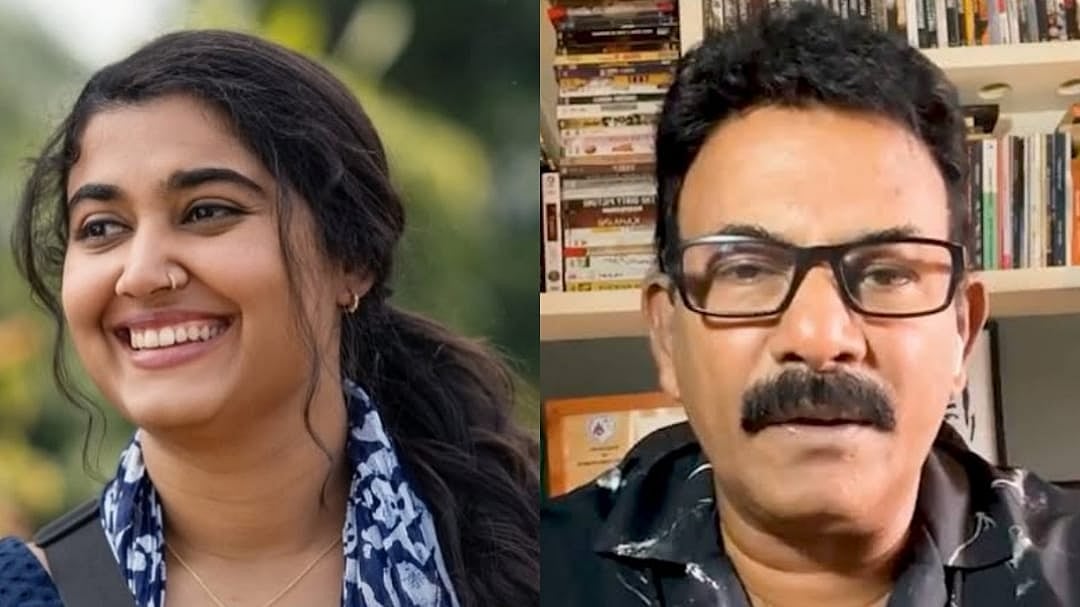
Follow TNM's WhatsApp channel for news updates and story links.When actor Vismaya Mohanlal shared an Instagram story asking a simple question — “do you genuinely believe this is how a democracy should respond to its own citizens?” — about the police crackdown on student protesters at Jantar Mantar, the reaction from a section of the internet was swift, ugly, and depressingly familiar. Her Instagram page was flooded with abuse. Old posts were dug up and defaced with hundreds of hostile comments. Some brought up her upcoming debut film, implying the post was some kind of publicity stunt. Others resorted to the great Indian pastime of whataboutery, demanding to know where she had been during every other injustice before this one. “You can ask your father about Prithviraj's plight before making such comments,” read one, a not-so-subtle reminder that actors, and their children, are expected to know their place.But it was BJP leader and filmmaker Major Ravi, her father Mohanlal’s close friend, who offered the most patronising defence of all, one that wasn’t really a defence so much as a demotion. Vismaya’s post, he explained, had nothing to do with politics. “She studied in Vietnam,” he reminded everyone, and doesn’t have much “political education.” According to him, this 30-something-year-old is simply a soft-hearted girl who cries when she sees stray dogs in distress. So when she saw children being beaten, she reacted the way any tender-hearted person would. Nothing more.It would almost be sweet, if it weren’t so insulting, and if Ravi hadn’t, in the very same breath, revealed exactly what he thinks a young woman's compassion is worth against his own political certainties.In a Facebook Live on the subject, Ravi shared rather robust views on the actual protesters, whose suffering apparently moved Vismaya to post in the first place. They aren’t “kutties, but kuttanmar” (not children, but rowdies). If they vandalised police vehicles and got pepper-sprayed for it, well, they had it coming, and there’s no point whining about it afterwards. The protest, he informed his followers, is foreign-funded — Soros money, no less — part of a Nepal-Sri Lanka-Bangladesh-style regime-change playbook now being run in Delhi. The real slogans, he said, aren’t about NEET at all, but about ousting Modi, freeing Umar Khalid and Sharjeel Imam, and restoring Article 370.So, to recap Ravi’s worldview in one sitting: student protesters getting lathi-charged and tear-gassed deserve it, because they are foreign agents executing a geopolitical conspiracy. And the woman who looked at visuals of that violence and shared a question about democracy was simply too politically ignorant to know any better.Notice what both halves of that argument are doing. One dismisses the protesters’ pain as illegitimate. The other dismisses a witness’s reaction to that pain as equally illegitimate, but via the gentler route of an inherently sexist and infantilising narrative of naivety. Either way, nobody’s stated reason for feeling something is allowed to stand on its own. Ravi alone gets to decide what things really mean.Now, if this all sounds like a rerun to Malayalis, that’s because it is. During the Empuraan row last year, when right-wing groups came after Mohanlal for the film’s depiction of something resembling the 2002 Gujarat riots, it was Ravi, again, who first stepped in to explain what Mohanlal actually thought.Mohanlal hadn't even watched the film, Ravi assured everyone on a Facebook Live, “just like he hadn't seen Keerthichakra (a Major Ravi film) before its release.” He never interferes with the script, doesn’t ask for corrections, just listens to the story once and trusts the makers. The actor was “deeply pained” by the controversy, Ravi said, and would soon release an apology. Trust me, he said, I know him.Days later, Mohanlal’s producer Antony Perumbavoor went on record to say the opposite of what Ravi had claimed. He asserted that Mohanlal knew the story from the outset, and the 24 cuts made to the film were creative decisions arrived at collectively, not the panicked damage control of a blindsided actor who hadn’t watched his own film.One may never know if Ravi is asked to be an unofficial spokesperson for the Mohanlal family or not, but it is worth asking why he deems it important to ‘put things straight’, specifically when the BJP or Hindutva politics is involved.The answer may not be complicated. The retired army man is now a formal BJP office-bearer, appointed the party’s Kerala state vice-president in 2023, and someone with a long and well-documented history of communal rhetoric that predates his party membership by years.Back in 2016, when a journalist was wrongly accused of calling goddess Durga a “prostitute” during a television debate, Ravi’s response was that he’d like to “spit on her face.” The journalist, Sindhu Sooryakumar, ended up receiving severe rape and death threats after Ravi’s comment circulated, even though she hadn’t even made the remark. It was actually read out by a BJP state secretary on her show. Later in 2017, an audio clip of Ravi’s surfaced calling on Hindus to “rise” in response to the Malabar Devaswom Board’s takeover of the Guruvayoor Parthasarathy temple: “Today 'they’ are getting into your temples, tomorrow ‘they’ will get into your homes... if you don’t rise now, they will enter your house, not just temples.” This is the man positioning himself as the reasonable, moderate voice explaining that a young actor’s political statement was really just an animal-lover’s soft heart.This infantilisation of Vismaya also happened within a larger, wearily familiar pattern in which Malayalam film personalities have paid a social media tax for saying versions of the same thing she did. Tovino Thomas called the police response to the protests repressive, and was met with communal abuse and a protest outside his home organised by (eight) Yuva Morcha activists. Parvathy Thiruvothu called the removal of activist Sonam Wangchuk from his hunger strike an “abduction of our rights” and faced similar hostility. Anchor Ranjini Haridas visited Jantar Mantar in solidarity and was targeted by, among others, BJP leader B Gopalakrishnan. But what’s especially interesting about Ravi’s response to Vismaya is how he dismisses her post as apolitical compassion, as if to suggest that compassion and politics are separate categories. He seems to suggest that noticing State violence against your fellow citizens and being moved to object to it is somehow a lesser, purely emotional reflex, as opposed to what it actually is — a political position, arrived at exactly the way most people arrive at political positions, through what they see and how it makes them feel.To be clear, the post Vismaya shared was hardly the revolutionary manifesto it has since been made out to be. It did not ask people to support the Cockroach Janata Party. It did not endorse the protesters’ demands. It did not attack the Union government or call for anyone’s resignation. Quite deliberately, it began by acknowledging that people need not agree with the protesters or even support their cause. It merely asked whether overwhelming force against citizens should become the State's preferred response to dissent.One may disagree with that question. One may even argue that the use of force was justified. But it is difficult to see how questioning the police action automatically becomes evidence that someone lacks political education.Vismaya, for her part, has said nothing since turning off her comments. Ravi’s comments may or may not have offended her, but I am offended for her.Views expressed are the author’s own.