
SC orders release of all student protestors, mulls SIT probe on police excesses
Follow TNM’s WhatsApp channel for news updates and story links.The Supreme Court, on Tuesday, July 28, ordered the release of all students arrested or detained during the recent nationwide protests, provided they have no criminal antecedents. The court also indicated that it may constitute
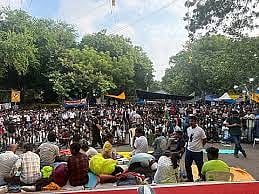
Follow TNM’s WhatsApp channel for news updates and story links.The Supreme Court, on Tuesday, July 28, ordered the release of all students arrested or detained during the recent nationwide protests, provided they have no criminal antecedents. The court also indicated that it may constitute a Special Investigation Team (SIT) headed by a former Supreme Court judge to conduct an independent probe into allegations of police excesses and violence during the demonstrations.A Bench comprising Chief Justice of India Surya Kant, Justice Joymalya Bagchi and Justice V Mohana passed a series of interim directions while hearing a batch of petitions alleging police brutality against student protesters, alongside petitions highlighting injuries suffered by police personnel and media persons during the protests.The court observed that the allegations raised before it warranted an independent investigation.The Bench observed, "The allegations made by petitioners prima facie make out a case for an independent and fair probe. Such a probe will effectively address allegations..."Chief Justice Surya Kant said, "Whoever has committed excess, committed atrocities on innocent people, law will take care of them. For that, there needs to be a completely independent and fair investigation. Probe is meaningless if no responsibility is fixed."The court directed all authorities to preserve CCTV footage, drone footage, body-worn camera recordings, wireless communication logs and Police Control Room (PCR) records related to the protests. It also ordered that the personal information and digital data of student protesters be preserved but not brought into the public domain, and restrained authorities from publishing the protesters' personal details.The Bench further directed that no coercive action be taken against students involved in the protests if they do not have criminal antecedents, and ordered all states to release such detained or arrested students. The court initially ordered the release of detained minors before clarifying that the direction would apply to all students without criminal antecedents.The Supreme Court issued notices to the Union government, the National Capital Territory of Delhi and the States of Assam, Bihar, West Bengal, Uttar Pradesh, Madhya Pradesh, Maharashtra and Kerala. The matter has been posted for further hearing on August 3.During the hearing, senior advocate Gopal Sankaranarayanan, appearing for one of the petitioners, argued that the issue extended beyond Delhi and concerned alleged police excesses across the country. He contended that established crowd-control protocols had been violated and alleged that plainclothes police personnel had participated in assaults on protesters.The Chief Justice acknowledged that peaceful protests are constitutionally protected and observed that violence during demonstrations could be caused by "uninvited guests" infiltrating protests, making an independent probe necessary to determine responsibility.Senior advocate Shyam Divan referred to allegations regarding the use of shock batons, pellet guns and violence by police personnel in plain clothes, while also urging the court to prohibit publication of protesters' personal data.Solicitor General Tushar Mehta, appearing for the Union and Delhi Police, submitted that the government did not oppose an independent investigation. Mehta said that if students had been attacked, "it is a serious matter," while also noting that around 250 police personnel were injured during the protests. He suggested that anti-social elements may have infiltrated the demonstrations and supported an inquiry monitored by a retired judge.The Chief Justice also observed that the existing protocols governing police handling of demonstrations required revision, stating that they had become outdated and that the issues should be addressed through a scientific and evidence-based inquiry.The petitions before the court seek, among other reliefs, an independent investigation into the alleged police action during the July 20 student protests, regulation of police conduct during public demonstrations, and guidelines governing the deployment of plainclothes personnel and the exercise of powers under the Bharatiya Nagarik Suraksha Sanhita (BNSS).