
‘Youth want transparency’: Bengaluru panel on strengthening democratic participation
Young leaders and civic activists came together at the Bangalore International Centre (BIC) on Saturday, July 11, to discuss what it takes to build a participatory democracy, arguing that young citizens are looking for transparency, accountability, and meaningful engagement beyond elections.The disc
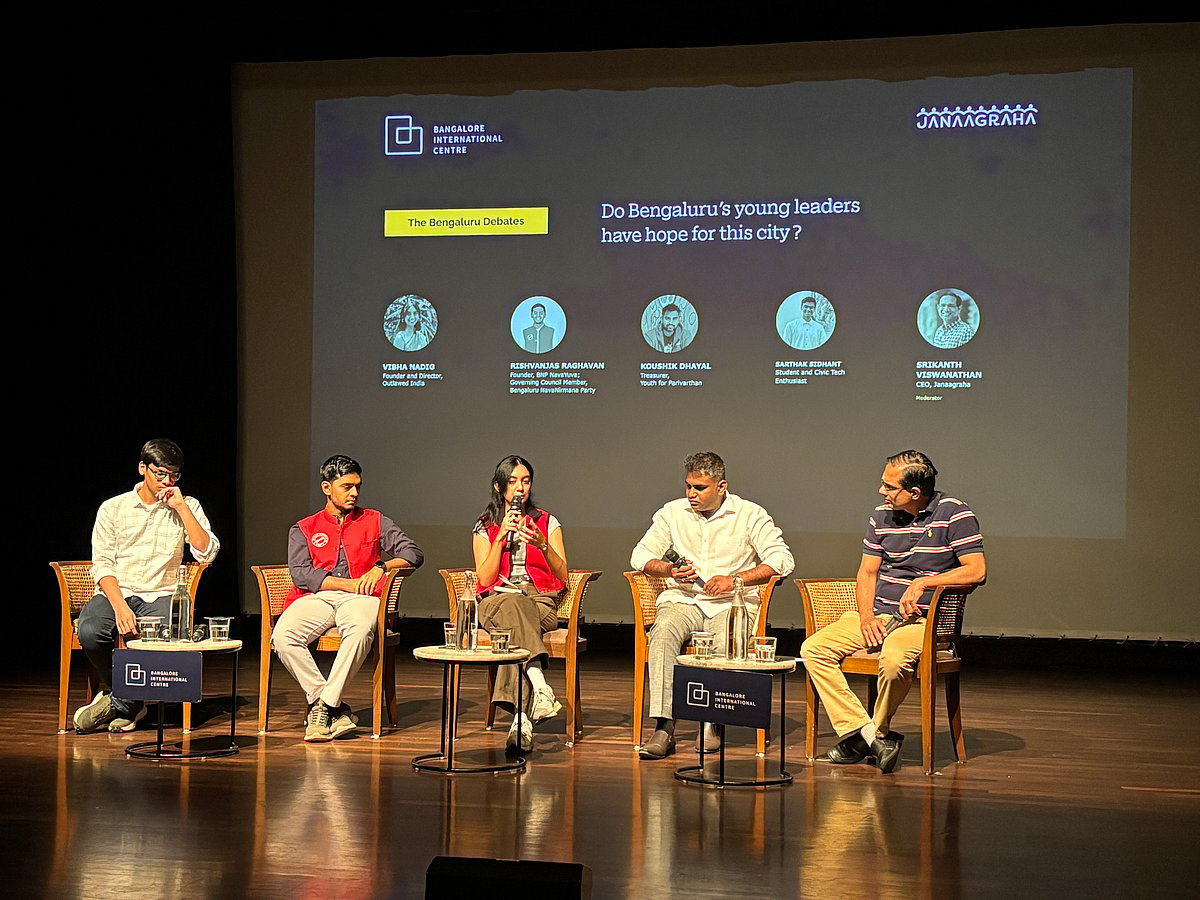
Young leaders and civic activists came together at the Bangalore International Centre (BIC) on Saturday, July 11, to discuss what it takes to build a participatory democracy, arguing that young citizens are looking for transparency, accountability, and meaningful engagement beyond elections.The discussion, titled Young Leaders Have Hope for the City, was part of the fourth edition of The Bengaluru Debates, a dialogue series organised by BIC and the Janaagraha Centre for Citizenship and Democracy. The panel featured student and civic-tech enthusiast Sarthak Siddhant, Outlawed India founder Vibha Nadig, Youth for Parivartan treasurer Koushik Dhayal, and BNP NavaYuva founder Rishvanjas Raghavan. It was moderated by Janaagraha CEO Srikanth Viswanathan.Opening the discussion, Srikanth asked the audience how many believed Bengaluru would be significantly better in the next 10 years. A majority of hands, particularly among the younger attendees, went up.The optimism, however, was in contrast with much of the discussion that followed, as panellists reflected on why Bengaluru continues to struggle with governance issues despite sustained civic engagement.Asked what young people want from democracy, the panellists converged on similar themes. Koushik Dhayal summed it up in one word, "transparency." Sarthak Siddhant chose "accountability", pointing to the CBSE marks controversy and the NEET paper leak as examples where, he argued, those responsible were never truly held accountable.Vibha Nadig cautioned against treating the youth as a single, homogeneous group. People's priorities differ depending on their circumstances, she said, noting that an unlit street may be a minor inconvenience for someone who can easily arrange transport home, but a serious safety risk for someone who cannot.Sarthak said his interest in civic accountability began with curiosity rather than activism. Frustrated by how difficult government portals were to navigate, he started analysing public tender data for irregularities and duplicate contracts before flagging his findings to journalists.Vibha spoke about Outlawed India's Nyaya Mitra programme, which trains community paralegals drawn from domestic workers, survivors of abuse and other underserved communities to help people file police complaints and pursue legal remedies. She said the initiative has expanded across Karnataka, with around 3,000 volunteers trained across 27 districts.Koushik described Youth for Parivartan's neighbourhood "spot-fix" campaigns, where volunteers repeatedly clean and reclaim garbage dumping sites to encourage long-term behavioural change. He said the initiative has achieved a success rate of about 75–80%.For Rishvanjas Raghavan, civic participation became personal after seeing vacant plots near his home in Mahalakshmi Layout turn into an illegal dumping ground despite repeated complaints by residents. "I don’t have the right to say anything if I can't clean up what's in front of my own house," he said.One of the more pivotal moments of the discussion came when the moderator Srikanth asked Rishvanjas how many of the households he had spoken to during his campaign were interested in public spending. Of the roughly 4,000 households he had canvassed, Rishvanjas said only about 2–3% expressed genuine curiosity about where public money was going.Sarthak offered a more optimistic assessment from his own experience, estimating that around a quarter of the young people in his circle would be interested in analysing civic data, while acknowledging that his peers represented a relatively privileged group.Vibha said access to justice is similarly shaped by privilege. Simply being able to cite the relevant law at a police station often changes how a complainant is treated, she said. More than 90% of participants in Outlawed India's paralegal programme, she added, said the programme's biggest impact was not legal knowledge but the confidence to engage with institutions they had previously found intimidating.The discussion also touched on sustaining civic engagement over time. Rishvanjas admitted to experiencing burnout after trying to respond to every issue from farmer protests and civic failures to international conflicts, before deciding to focus on problems where he believed his own efforts could make the greatest difference.Closing the session, Srikanth announced a series of ward-level consultations beginning on July 18 to crowdsource a citizen agenda ahead of Bengaluru's long-delayed BBMP elections. Drawing on Janaagraha's two decades of civic engagement, he acknowledged that public demand for accountability remains insufficient to consistently drive systemic change.Koushik ended with what became the panel's central message: "The smallest action is better than the loudest words." Vibha echoed the sentiment, telling the audience that civic participation should not be viewed as an exception, but as a choice available to everyone.This article was written by a student interning with TNM.